
There are no fully online, 12-month entry-level physician assistant (PA) programs that qualify first-time students for certification in the United States. When people search “12-month” or “accelerated,” they almost always land on one of three real paths: about a year online for certified PAs finishing a master’s, a hybrid or campus entry-level master’s around 24–28 months, or a dual bachelor’s + master’s from high school that runs about 5–6 years total.
If you want to become a PA—or you already are one and need a faster next credential—start with where you are today. The path that fits you depends less on brand names and more on whether you need entry-level training or a completion / postgraduate degree.
At a Glance
| Question | Answer |
|---|---|
| Fully online entry-level PA school? | No—entry-level training is hybrid or campus, not fully online in 12 months |
| Shortest common entry-level path (with bachelor’s) | About 24 months (hybrid or campus master’s) |
| Shortest common fully online option | About 12-month master’s completion (already certified PAs only) |
| Clinical rotations required to become a PA? | Yes (entry-level) |
| Eligible for first PANCE after a completion-only degree? | No—completion assumes you already finished entry-level training |
| What “accelerated PA” usually means | Dual BS/MS (~5–6 years) or hybrid multi-year master’s—not one online year from scratch |
Pro tip: Pace’s online master’s completion is open for certified PAs; Touro’s NY completion and Yale PA Online are closed to new students (Yale is in teach-out). Program status changes, so open the school’s live page before you spend application fees.

Decision Path: Which Track Fits You?
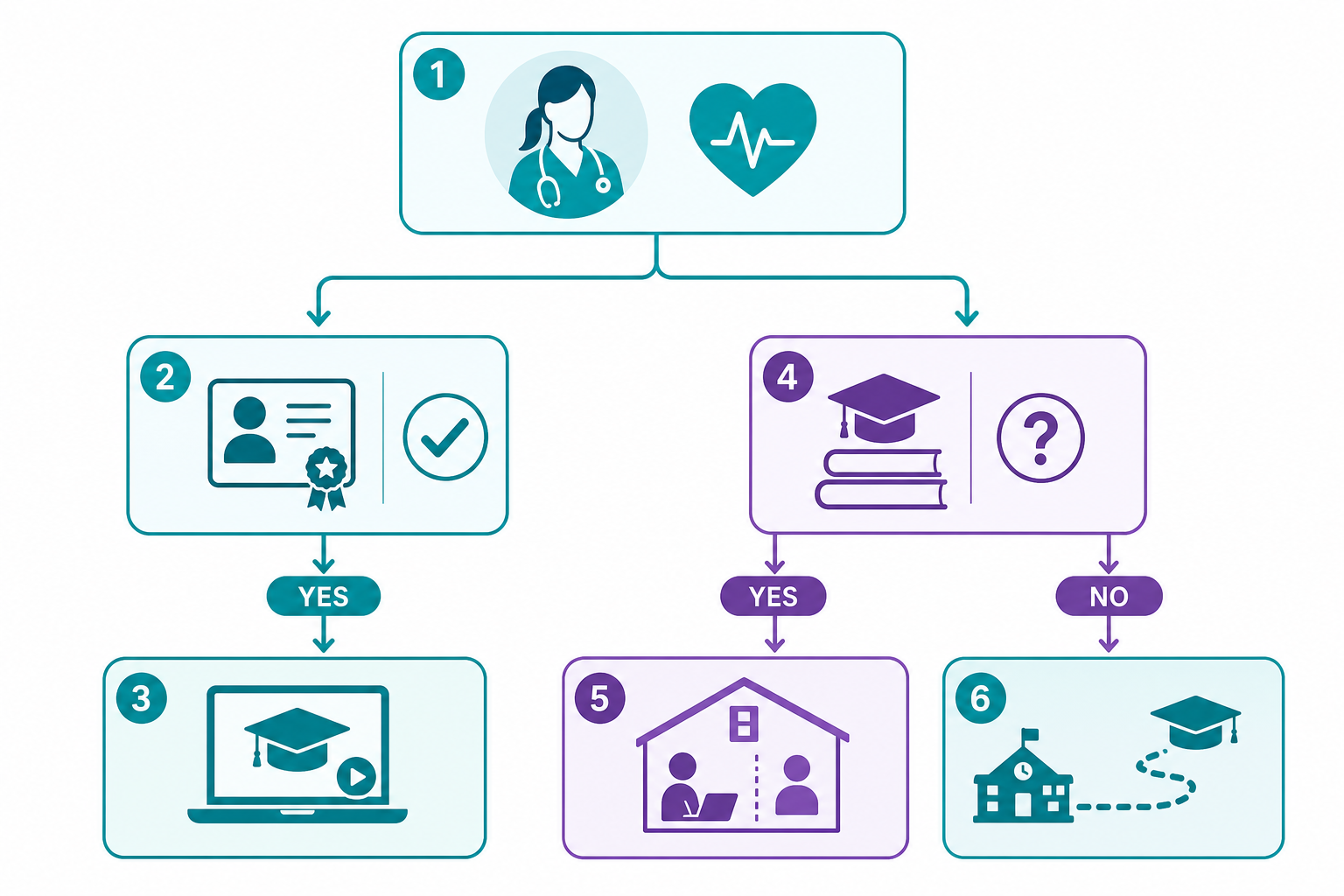
Here’s the simple decision tree:
- Already a certified PA? Look at Path 1 (about 12 months online for a master’s completion) or Path 4 (a post-professional doctorate).
- Not a PA yet, but you already have a bachelor’s? Path 2—about 24 months hybrid or campus entry-level master’s—is the realistic “fast” route.
- Still in high school or early college? Path 3 (dual BS/MS, about 5–6 years) can be the shortest total timeline if you’re sure PA is the goal.
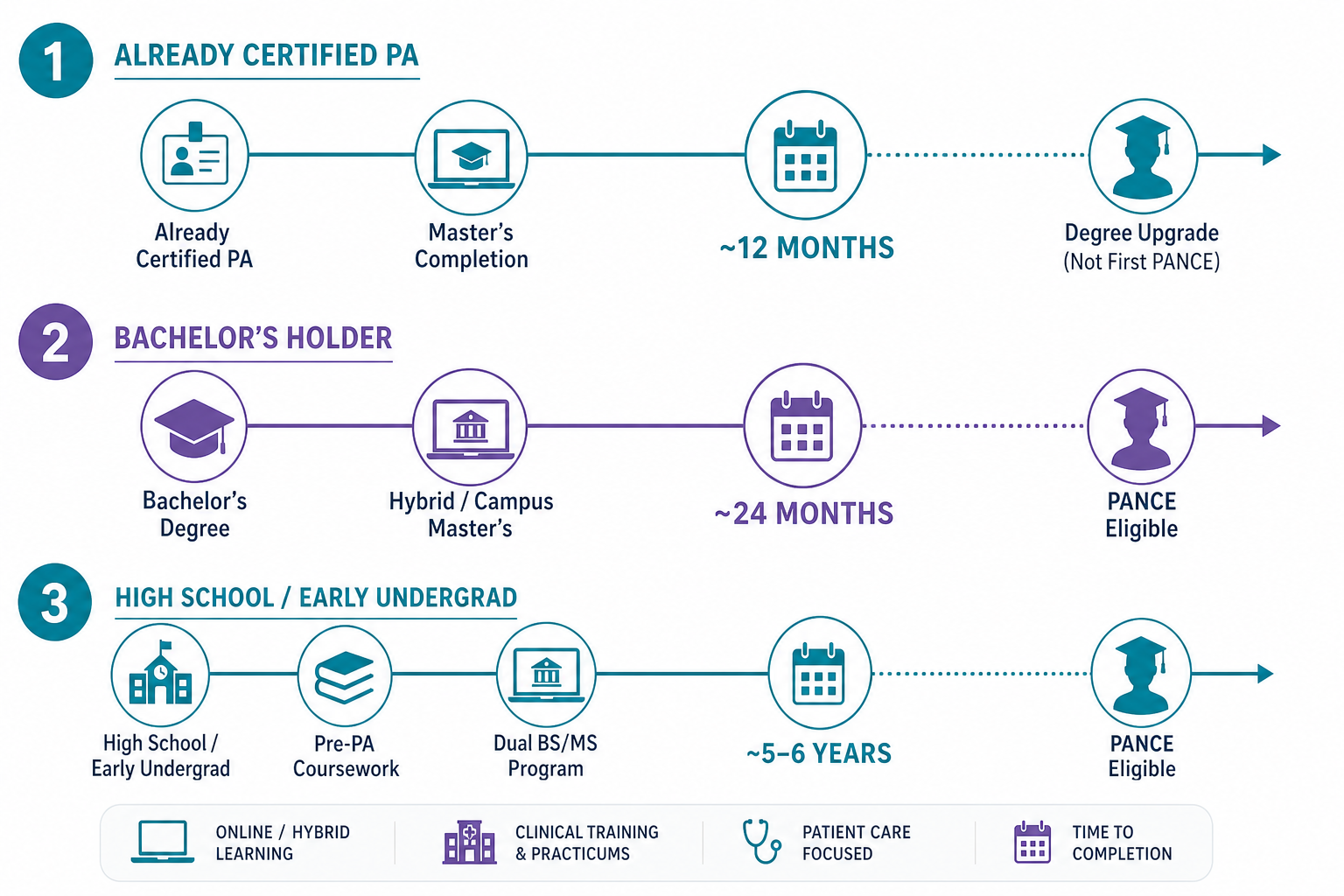
Timeline view: Already a PA → completion (~12 mo). Bachelor’s → hybrid master’s (~24 mo) → PANCE. High school → dual BS/MS (~5–6 yrs) → PANCE.
Start Here: Which Fast Path Are You Actually Eligible For?
Forget brand names for a second. The first filter is your education and certification right now.
- Not a PA yet (first-time student): You need an entry-level ARC-PA accredited program, then the PANCE. There is no legitimate fully online 12-month version of this path. Your real “fast” options land around 24–28 months hybrid or campus, or a 5–6 year dual BS/MS if you’re still early in undergrad (or applying from high school).
- Already a certified PA (often bachelor’s-trained) and aiming for a master’s: You may fit a ~12-month online master’s completion / bridge program—Pace’s online completion MS is a solid example. That does not replace entry-level training; you already finished it.
- Already a master’s-level PA-C looking for a terminal degree: Online post-professional doctorates (DMSc / DScPAS-style) often run about 12–18 months or longer depending on school and load. They are not a first certification shortcut.
These paths serve different students and different outcomes. Twelve months online almost always means a completion or post-professional track for people who are already PAs—not a one-year license from scratch.
- At a Glance
- Decision Path: Which Track Fits You?
- Start Here: Which Fast Path Are You Actually Eligible For?
- Path 1: True ~12-Month Online Programs (Certified PAs Only)
- Path 2: Accelerated-Feeling Entry-Level Programs (Usually Hybrid, ~24–28 Months)
- Path 3: Dual BS→MS Accelerated PA Programs (Campus Tracks)
- Path 4 (Bonus): Online Post-Professional Doctorates for Credentialed PAs
- Side-by-Side Comparison
- How to Choose Without Confusing Program Types
- Admission Requirements Snapshot
- Are Short Online PA Programs Legitimate?
- Definitions
- How to Check Programs Before You Apply
- What “Accelerated” and “12-Month” Actually Mean
- How Common Is Each Path?
- Feature Comparison: Completion vs Hybrid vs Dual vs Doctorate
- Common Mistakes Applicants Make
- Related Guides (PA Education Cluster)
- People Also Ask: 12-Month & Accelerated PA Programs
- Conclusion
- References
Path 1: True ~12-Month Online Programs (Certified PAs Only)
Here’s what a true ~12-month online PA program looks like in practice: fully or mostly online, about a year, built for practicing PAs who need a master’s (or bridge coursework) for a job, promotion, teaching, administration, or research.
Pace University — Physician Assistant Online Completion
Pace positions this as a way to accelerate your career after you’re already a certified PA—not as first-time PA school. From Pace’s program pages:
- Audience: Certified physician assistants with an undergraduate degree seeking a PA master’s
- Format: Fully online; Pace lists the modality as asynchronous
- Length / load: About 1 year / 30 credits; Pace lists full-time and part-time options (CHP page also describes ~12 months / four semesters)
- Published total program cost: $10,570* on Pace’s program page (*current-year figure; subject to change)
- Sample course themes: Epidemiology/evidence-based medicine, health promotion, research methods, leadership in healthcare (check the current catalog for your term)
- Sources: Pace MS completion program page · Pace PA Online Completion overview
Touro (NY School of Health Sciences) master’s completion — closed to new applicants
Touro used to offer a one-year Physician Assistant Master’s Completion program. That program is no longer accepting new applications, and Touro’s SHS page points practicing PAs toward Touro University Nevada’s online Doctor of Physician Associate (DPA)—a doctoral path, not the same master’s completion. Skip it if you’re shopping for an open one-year master’s. Source: Touro SHS PA Master’s Completion notice.
Other bridge / degree-completion patterns (check open status)
- Older bridges may already be gone: Degree-completion tracks at schools such as Augusta University or UTRGV may no longer be open. Some old marketing links no longer land on a live bridge (Augusta’s current PA pages describe the entry-level master’s). Open the school’s live page before you bank on a bridge still existing.
- How to check any named completion program: Open the university’s current program page and look for who may enroll (already certified PA only vs first-time student), length, fully online vs hybrid, total cost, and whether applications are open.
Accreditation note: Entry-level ARC-PA status applies to the program that first prepared you for the PANCE. Completion degrees are a different product. Make sure the credential is the one employers or graduate schools actually want from you.
Path 2: Accelerated-Feeling Entry-Level Programs (Usually Hybrid, ~24–28 Months)
If you’re not a certified PA yet, “accelerated PA programs online” almost always means hybrid: online coursework plus campus skills time plus supervised clinical rotations. Entry-level master’s training commonly runs about 24–36 months. You can’t squeeze ARC-PA entry-level education into one remote year—and honest schools won’t claim you can.
What a modern hybrid year looks like (Nazareth as a clear example)
Nazareth University’s hybrid MS is a clear template when you’re comparing other hybrids:
- Total length: About 24 months full-time
- Year 1 (didactic): Primarily live online courses on set weekdays (synchronous), plus orientation and roughly one on-campus week each semester for skills and assessments
- Year 2 (clinical): Full-time supervised rotations (Nazareth describes nine rotations across medical settings), with short campus returns between blocks
- Logistics schools may not lead with: Clinical sites often concentrate in one region (for Nazareth, primarily New York). If you live elsewhere, budget travel, temporary housing, and clinical-year living costs. Placement is program-directed, not a guarantee of your preferred zip code
- Accreditation: Check current ARC-PA status (Nazareth has held Accreditation-Provisional—provisional is not the same as continued status; read what that means for your risk tolerance)
Other hybrid entry models applicants compare
- University of North Dakota MPAS: About 2 years (90 credits per UND). Mix of online coursework (including live online classes) with on-campus experiences and clinical training; mission emphasis on rural and underserved care. ARC-PA Accreditation-Continued (as published by UND). Read UND’s current pages for placement rules.
- University of Pittsburgh and other newer hybrid PA cohorts: Discussed in applicant forums as part of a growing hybrid set—still multi-year, still clinical-heavy.
- Live online vs self-paced: Live weekday class (Nazareth-style) is not the same as self-paced modules (more common in completion tracks). Know which one you’re signing up for before you commit.
Yale PA Online: do not plan around it
Yale’s hybrid online entry program is closed to new students. Per Yale’s update, PA Online will not admit future students, will graduate its final class in 2026, and ARC-PA will withdraw accreditation effective September 30, 2026. Through that date the online program stays accredited on probation for teach-out of enrolled students only (Yale’s separate campus PA program is unaffected). Don’t build your plan around it. Details: Yale Physician Assistant Online Program.
Path 3: Dual BS→MS Accelerated PA Programs (Campus Tracks)
In PA education, “accelerated” usually means a combined bachelor’s + master’s pathway started from high school—not a fully online 12-month completion degree. That’s a different product from Path 1. Already certified and need a one-year online master’s? Stay on Path 1. Heading toward college with a long-term PA plan? This dual path is the one for you.
Examples of dual-track models (lengths and details change—check each school’s site):
| Example dual / accelerated program type | Typical length | What to check |
|---|---|---|
| Seton Hall University B.S./M.S. | ~6 years | Current dual structure on the school site |
| Le Moyne, DeSales, Hofstra, Duquesne, Gannon, Butler B.S./M.S. | ~5 years | Often continuous / 3+2-style dual models |
| Drexel B.S./M.H.S.-style dual | ~5.25 years | Current dual length and credentials |
Published total-cost estimates for dual programs often land in the mid-to-high six figures when you stack four undergrad years of science-major tuition with graduate PA costs, fees, and inflation. Treat those as ballparks, not a single bill. Dual tracks are almost always campus-intensive, not remote yearlong degrees.
What a strong dual track usually looks like
Look past the “fast” label and check:
- ARC-PA status: Prefer full Accreditation-Continued when possible; provisional/probationary status carries curriculum and timeline risk.
- PANCE outcomes: First-time or multi-year pass rates (many programs aim well above ~90% first-time or multi-year rates).
- Clinical depth: Rotation weeks, specialty spread (family med, EM, surgery, pediatrics, behavioral health, etc.), and whether sites sit in high-volume systems.
- True curriculum integration: Seamless undergrad → graduate transition—not a rushed bachelor’s bolted onto a separate master’s with little planning.
Accelerated dual vs traditional path
- Dual / accelerated: Continuous BS→MS about 5–6 years from college entry. Conditional graduate seat often secured as an incoming freshman. Saves roughly one to three calendar years vs the long traditional sequence by removing the gap year(s) between applications.
- Traditional: Four-year bachelor’s + separate competitive master’s PA application (~2–3 years) → often 6–8 years total, with more time to build clinical hours and change majors.
- Same destination standards: Both paths, when ARC-PA accredited, prepare for the same PANCE and scope of practice. Length and structure differ—not a second-class clinical degree.
- Trade-off: Dual tracks buy earlier workforce entry and fewer enrolled years of rent/tuition—if you are certain about PA. Intensity is high (year-round coursework, little downtime, limited outside work).
- Geographic reality: Direct-entry dual pathways cluster in the Northeast, Mid-Atlantic, and Midwest. California doesn’t offer the same well-known dual BS/MS entry the same way; CA students usually finish a bachelor’s, then apply to graduate programs (strong options include Stanford, Loma Linda, USC Keck, and UC Davis—check each school’s current admissions).
- Scale: Only a small minority of U.S. PA schools offer dual-entry acceleration—on the order of roughly ~40+ dual pathways versus roughly 330 ARC-PA accredited entry-level programs overall (counts change).
- Selectivity: Dual tracks are among the most competitive pre-health admits. Expect high GPA bars, strong test scores when required, science-heavy prep, and early healthcare exposure. Undergraduate dual cohorts are often small (tens of seats). Read each school’s published class size and progression requirements.
How to choose a dual accelerated program (if you are a dual candidate)
- Start with ARC-PA status and PANCE rates—not branding alone.
- Map clinical placements: Ask how many rotation weeks, which specialties, and whether students train in major health systems / high-volume sites vs only small clinics.
- Curriculum style: Body-system integrated blocks vs discipline-by-discipline sequences suit different learners—request a curriculum map.
- Cohort size and mentorship: Smaller dual cohorts can mean closer faculty access. Ask whether faculty mentors and upper-class student mentors are formal—not just “office hours.”
- Progression risk: Dual admission is usually conditional. Understand GPA floors, shadowing/patient hours, and other requirements to keep the graduate seat.
Fastest realistic routes (by starting point): High school + certain about PA → dual BS/MS (~5 years at places like Le Moyne- or Hofstra-style 3+2/five-year models) is often the shortest total timeline. Already hold a bachelor’s → shortest common entry-level master’s is about 24 months (hybrid or campus)—not a remote year, and not a dual high-school admit reboot.
Path 4 (Bonus): Online Post-Professional Doctorates for Credentialed PAs
Post-professional doctorates (DMSc, DScPAS, DPA, and similar) are for practicing PAs who already finished entry-level education and certification. Length varies by school and load—often about 12–18 months full-time equivalent, sometimes longer part-time. One open example is Rocky Mountain University’s online Doctor of Medical Science (RMU markets about 16 months with multiple specialty tracks). Other schools in this market include University of Nebraska Medical Center, A.T. Still University, MCPHS, and Touro University Nevada—match the credential to your goal and check whether applications are open. These degrees do not create first-time PAs.
Side-by-Side Comparison
| Path | Common name | Who can enroll | Typical length | Mostly online? | Leads toward first PANCE? |
|---|---|---|---|---|---|
| Master’s completion / bridge | 12-month PA online | Already certified PAs | ~12 months (e.g., Pace online MS, 30 credits) | Usually fully online | No |
| Hybrid entry-level master’s | Accelerated / online PA program | First-time PA students with bachelor’s | ~24–28 months | Didactic online + campus labs + clinicals | Yes, if ARC-PA entry-level |
| Dual BS→MS | Accelerated PA program (dual BS/MS) | HS / early undergrad commits | ~5–6 years total | Usually campus-heavy | Yes, if ARC-PA entry-level |
| Post-professional doctorate | Online PA doctorate | Master’s-level PA-Cs | Often ~12–18+ months | Often fully online | No |
How to Choose Without Confusing Program Types
- Filter by eligibility first. A dual BS/MS pathway does not answer “12-month online for me” if you are already a bachelor’s-trained non-PA—or a certified PA seeking a completion master’s.
- For entry-level hybrid: Check current ARC-PA status, multi-year PANCE rates, how clinical placements work, and whether online classes are live or flexible.
- Budget clinical-year reality: Hybrids still create travel and housing costs. Ask where rotations sit and who assigns sites.
- Do not plan full-time work during entry-level or dual accelerated phases. Dual and hybrid clinical years often run 40+ hours/week; programs commonly discourage outside jobs. Online master’s completion tracks for working PA-Cs are the exception.
- For dual-degree acceleration: Weigh PANCE outcomes + ARC-PA status + clinical depth + mentorship (faculty + peer) + progression rules—not total-tuition estimates alone.
Admission Requirements Snapshot
~12-month online completion / bridge
- Graduation from an accredited PA program
- NCCPA certification (PA-C)—or status defined by the school
- Current certification and, at some schools, active clinical employment or practice requirements
- Bachelor’s degree; ability to complete an online curriculum (full-time or part-time depending on school)
Hybrid entry-level master’s (~24 months)
- Bachelor’s degree (unless dual-track undergrad)
- Science prerequisites (anatomy, physiology, chemistry, microbiology, etc.)
- Hands-on healthcare experience hours (quality matters as much as quantity)
- CASPA (for most), recommendations, interviews; GRE/PA-CAT as required or waived
Dual BS→MS accelerated
- Competitive high school / early college profile (high GPA/test bars when required, and strong science preparation)
- Early commitment to PA; progression requirements to keep the graduate seat
- Limited outside work once graduate-phase intensity begins
Are Short Online PA Programs Legitimate?
A short online PA program can be legitimate—or a mismatch—depending on type. Entry-level programs that lead to PANCE eligibility must meet ARC-PA standards and include substantial supervised clinicals. That’s why a true fully online yearlong first-time path isn’t on the map. Online completion and doctoral programs can be solid for people who are already PAs, but they answer a different question than “How do I become a PA online in a year?” Start with accreditation status, published attrition and PANCE data, and whether the program is still accepting students.
Definitions
What is a physician assistant master’s completion program?
A degree-completion (or bridge) master’s designed for people who already completed entry-level PA education and certification and now need a master’s credential. Example: Pace University’s online PA master’s completion (~1 year, asynchronous, certified PAs with an undergraduate degree). See also our sibling page on online physician assistant programs for hybrid formats.
What is an accelerated PA program?
An “accelerated” PA path is usually a dual bachelor’s + master’s (continuous ~5–6 years from college entry), not a one-year online pathway for non-PAs. Hybrid multi-year master’s programs are also sometimes described as accelerated relative to longer campus models.
What is a hybrid PA program?
A hybrid PA program delivers a large share of entry-level didactic coursework online (often live) while still requiring campus skills time and full supervised clinical rotations. Total length is usually about 24–28 months—not a fully remote year.
What is ARC-PA accreditation?
ARC-PA is the Accreditation Review Commission on Education for the Physician Assistant. Entry-level programs that prepare graduates to seek the NCCPA PANCE should hold current ARC-PA accreditation. ARC-PA currently lists about 330 accredited entry-level programs (count changes).
How to Check Programs Before You Apply
- Open current university catalogs and official program pages—not old ranking lists
- Check ARC-PA and school-published accreditation status for any entry-level program you’re considering
- Make sure admissions are open (or labeled closed / teach-out) before you apply
- Treat master’s completion, hybrid entry-level, dual BS/MS, and post-professional doctorates as separate products—not interchangeable “fast PA” labels
- Treat dual-entry pathway counts (~40+) as approximate scale, not a hand census of every campus
What “Accelerated” and “12-Month” Actually Mean
Here’s the pattern you’ll see when you look at programs labeled online, accelerated, or about 12 months:
- Distinct products: Master’s completion, hybrid entry-level, dual BS/MS, and post-professional doctorates each have different eligibility rules—they are not interchangeable.
- Status changes: Several once-marketed options are closed to new applicants or in teach-out (for example Touro NY master’s completion and Yale PA Online for new students).
- What “accelerated” covers: Among programs described as accelerated, nearly all fall into dual BS/MS, hybrid multi-year entry, or post-professional tracks—not a true one-year entry-level path for first-time students.
- What “12-month online” covers: About 12 months online usually describes a completion or post-professional degree for people who are already PAs—not first-time entry-level training. Eligibility is the sorting key.
- Scale: Roughly 330 ARC-PA accredited entry-level programs overall vs roughly 40+ dual pathways, and relatively few verified open online completion options for bachelor-trained certified PAs.
How Common Is Each Path?
| Path type | Approximate scale | Notes |
|---|---|---|
| ARC-PA accredited entry-level programs | About 330 | ARC-PA currently accredited directory phrasing; counts change |
| Direct-entry dual BS/MS accelerated pathways | Roughly 40+ | Approximate order of magnitude—not a full independent census |
| Open fully online ~12-month completion master’s | Few verifiable live options | Pace is a clear open example; several historically marketed programs are closed or unverifiable |
| Post-professional online doctorates (DMSc-style) | Growing set of schools | For already certified PAs; length often ~12–18 months |
Feature Comparison: Completion vs Hybrid vs Dual vs Doctorate
| Feature | Completion / bridge | Hybrid entry master’s | Dual BS→MS | Post-pro doctorate |
|---|---|---|---|---|
| Already a certified PA? | Yes (required) | No | No | Yes (usually master-trained PA-C) |
| Primarily online? | Usually fully online | Partially (didactic + campus + clinicals) | Rarely—mostly campus | Often fully online |
| Clinical rotations required in this program? | No new entry rotations for first PA license | Yes | Yes (graduate phase) | No entry-level clinicals |
| Leads to first PANCE eligibility? | No | Yes (if ARC-PA entry-level) | Yes (if ARC-PA entry-level) | No |
| Typical length | ~12 months | ~24–28 months | ~5–6 years total | ~12–18+ months |
| Designed for full-time outside work? | Often yes / flexible | Usually no | Usually no in graduate phase | Often for practicing clinicians |
| How common? | Relatively rare open options | Growing hybrid subset of ~330 entry programs | ~40+ dual pathways; minority of schools |
Common Mistakes Applicants Make
- Confusing completion with entry-level: A ~12-month online master’s for certified PAs does not train you for the PANCE if you are not already a PA.
- Believing “online” means no clinicals: Entry-level pathways require substantial supervised clinical practice even when didactic work is remote.
- Assuming a named program still admits students: Status changes—examples include Touro NY master’s completion (closed) and Yale PA Online (teach-out for enrolled students only).
- Assuming “accelerated” equals one year: Dual BS/MS acceleration is usually about 5–6 years total; hybrid entry is still multi-year.
- Skipping accreditation checks: Entry-level PANCE eligibility depends on current ARC-PA status—not marketing language alone.
Related Guides (PA Education Cluster)
Want to go deeper? Start here:
- Online and hybrid physician assistant programs (sibling page for broader online/hybrid entry structure)
- ARC-PA currently accredited programs (accreditation entity directory)
- CASPA (common graduate PA application system)
- NCCPA / PANCE (certifying exam context for entry-level graduates)
- Physician assistant career guide, degrees to become a PA, and online PA programs
People Also Ask: 12-Month & Accelerated PA Programs
Short version: you can’t become a PA for the first time in a fully online 12-month program. Entry-level training usually takes about 24 to 28 months and includes clinical rotations. About 12 months online is realistic only if you’re already a certified PA finishing a master’s completion degree—Pace’s online completion program is about one year.
Can you become a PA online in 12 months?
No. You cannot complete entry-level PA training fully online in 12 months and qualify for first-time certification. Accredited entry-level programs take about 24–28 months and require in-person clinical rotations. About 12 months online usually refers to a master’s completion program for already certified PAs.
How long does a physician assistant program take to complete?
Most entry-level PA master’s programs take about 24 to 28 months of continuous full-time study. Some hybrid or distance tracks run closer to 24–36 months. Online master’s completion for certified PAs often runs about 12 months. Dual BS/MS accelerated tracks commonly take about 5 to 6 years from college entry.
Are there fully online PA programs for first-time students?
Not for full training. Entry-level “online” PA paths are almost always hybrid: remote didactic coursework plus required labs or immersions and supervised clinical rotations. Fully online formats are more common for post-professional or master’s completion degrees for people who are already PAs.
Are accelerated PA programs the same as 12-month online PA programs?
Usually no. “Accelerated PA program” usually means a dual bachelor’s + master’s campus track of about 5–6 years. “12-month online PA” more often means a master’s completion degree for certified PAs. Hybrid entry-level master’s programs (~24 months) sit in the middle. Match the program type to your eligibility before you apply.
What is the difference between a PA master’s completion program and an entry-level PA program?
An entry-level program is for first-time PA students. It includes didactic and clinical training so graduates can take the PANCE. A master’s completion program is for already certified PAs who need a master’s degree (for example for employment or academic goals). Completion does not replace initial PA school.
Can you work while in an accelerated PA program?
Usually not in dual or hybrid entry-level tracks. Year-round coursework and clinical rotations (often 40+ hours/week) leave little capacity, and many programs discourage or prohibit outside employment. Limited part-time work is sometimes possible early in dual undergrad years only. Online master’s completion programs for certified PAs are the main type designed for working clinicians.
What do you need to get into a PA program?
Entry-level graduate programs usually require a bachelor’s degree, science prerequisites, healthcare experience hours, recommendations, and a CASPA application; some still use GRE or similar tests. Dual accelerated high-school entry emphasizes GPA, rigor, tests when required, and early healthcare exposure. Completion programs usually require prior PA education, current certification, and a bachelor’s degree; other requirements vary by school.
Is Yale PA Online still accepting students?
No for new students. Yale’s Physician Assistant Online Program is teaching out enrolled students, plans to graduate its final class in 2026, and ARC-PA will withdraw accreditation for that online program effective September 30, 2026. Through that date the online program remains accredited on probation for teach-out only. Yale’s separate campus-based PA program is a different offering.
Conclusion
“12-month physician assistant programs online” and “accelerated PA programs” only make sense once you name your starting point. If you’re already a certified PA, real ~12-month online completion options like Pace’s are worth a close look. If you’re becoming a PA for the first time, compare ~24-month hybrid master’s programs and dual BS/MS tracks—not a fully online year that doesn’t exist. Open the school page, match the program type to your eligibility, and take the next step when the fit is clear. For the broader hybrid and entry landscape, see online physician assistant programs.
References
- ARC-PA Currently Accredited Programs (~330 entry-level programs as stated by ARC-PA; counts change)
- Pace University PA Master’s Degree Completion Program, MS
- Pace University PA Online Completion (CHP overview)
- Touro SHS PA Master’s Completion (no longer accepting applications)
- Nazareth University Hybrid PA Master’s
- University of North Dakota MPAS
- Yale Physician Assistant Online Program (teach-out / probation notice)
- Rocky Mountain University Doctor of Medical Science (DMSc)
- Inspira Advantage: Accelerated PA Programs
- Indeed: Online and Hybrid Physician Assistant Programs
- BeMo: Online Physician Assistant Programs
- EduMed: Online Physician Assistant Programs
- Rocky Mountain University Physician Assistant / DMSc
- CASPA
- Allied Health Schools: Online Physician Assistant Programs